
February 4, 2026 | Pillar Content | Written by Victoria Guzzo | 2 min read
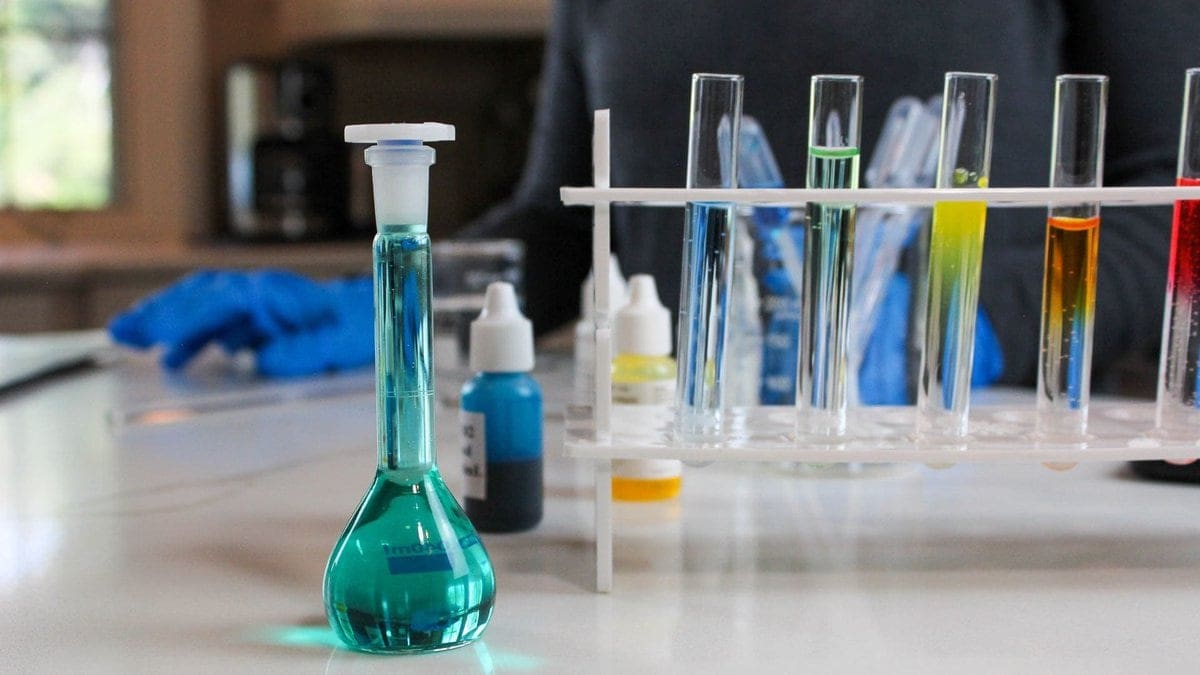
Chemistry labs are taught across online, on-campus, and hybrid formats, but the expectations for rigor, safety, and student understanding remain the same. Students need opportunities to observe reactions, collect data, and apply quantitative reasoning, not just watch simulations or review theory.
The most effective college chemistry labs balance hands-on experiences with virtual reinforcement. Hands-on labs give students the chance to work with real materials, collect data, and connect structure to function in meaningful ways. When paired with virtual labs, students have the opportunity to repeat labs in a lower stakes environment, reinforce key concepts, and feel more prepared. Together, this blended approach supports student readiness, protects instructional time, and delivers consistent outcomes across online and on-campus chemistry courses.
From Theory to Practice: How Chemistry Labs Work in Practice
Delivering high-quality chemistry labs comes down to fit and focus. Instructors need labs that align with their existing course goals, support meaningful student engagement, and maintain academic rigor without adding prep time or logistical complexity. The most effective chemistry lab solutions are flexible where they need to be, structured where it matters, and designed to support teaching, not compete with it.
Step 1: Select College Chemistry Labs Aligned to Outcomes
With ready-made kits that align with chemistry courses, we offer 65 peer-reviewed A&P labs that instructors can customize based on their course objectives.
Step 2: Prepare Students With Virtual Labs
Virtual labs and pre-lab activities introduce procedures, reinforce safety, and support readiness. The majority of students (84%) who completed required pre-labs said they felt more prepared, and 91% said doing a trial experiment virtually further improves readiness.
Step 3: Deliver Hands-On Labs Wherever Students Learn
Hands-on labs are completed using lab kits shipped directly to students or your campus. Students work with lab-grade materials and collect authentic data regardless of location.
Step 4: Teach, Assess, and Support
Streamlined lab management portals with built-in OpenStax textbooks and LMS integrations reduce grading and prep time, allowing instructors to focus on feedback, analysis, and student growth.
| 80% of instructors said hands-on labs were easy to incorporate in their courses |
What Chemistry Labs Look Like in Practice
Blended lab design allows instructors to align modality with learning objectives. In chemistry labs, students may complete hands-on experiments such as titrations or calorimetry, while virtual labs support concepts like molecular structure or reaction kinetics when physical equipment is impractical. This balance allows college chemistry labs to remain rigorous while managing cost, access, and feasibility. Let’s look more closely at three of our most popular hands-on and virtual chemistry labs.
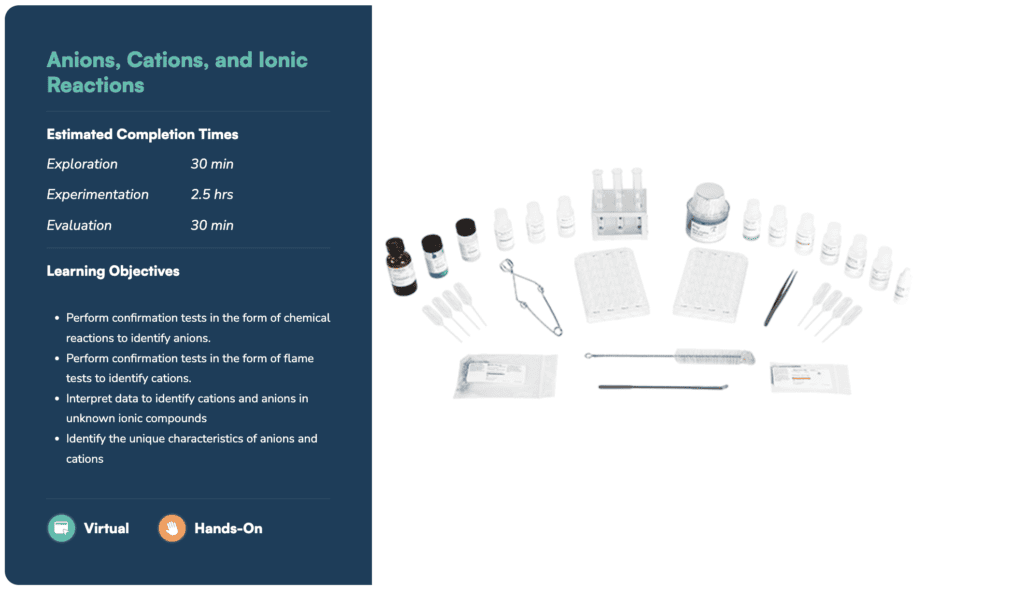
Cations, Anions, and Ionic Reactions
In this hands-on chemistry lab, students will analyze ionic reactions through flame tests and confirmation reactions to identify cations and anions and interpret how ionic properties drive observable chemical behavior.
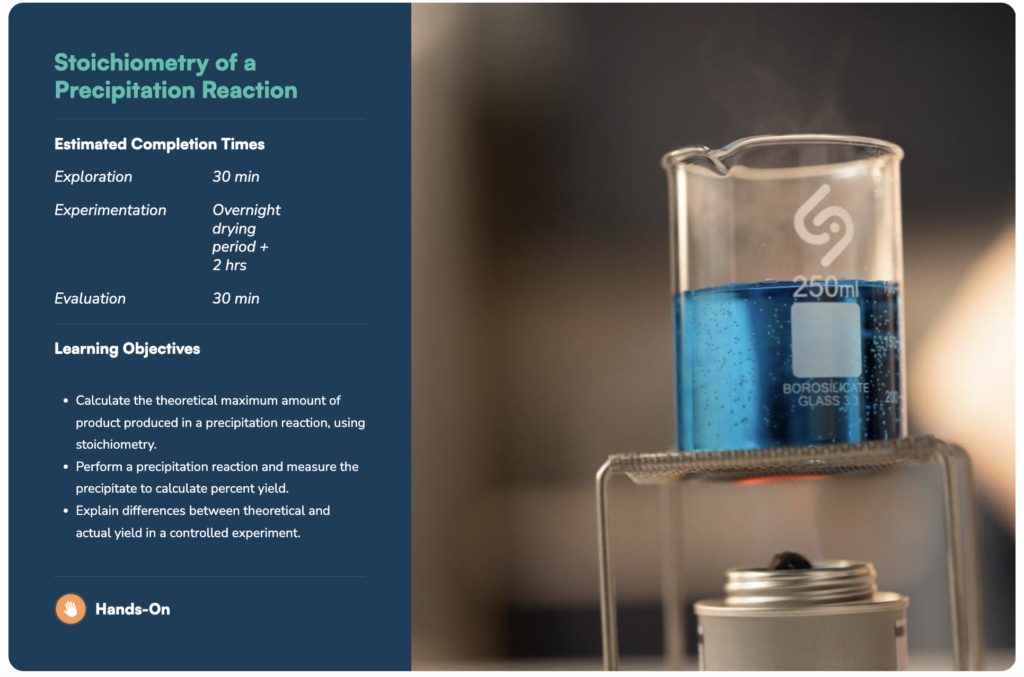
Stoichiometry of a Precipitation Reaction
In this hands-on chemistry lab, students will apply stoichiometry to a precipitation reaction by calculating theoretical yield, measuring actual product formation, and analyzing the factors that affect percent yield in a controlled experiment.
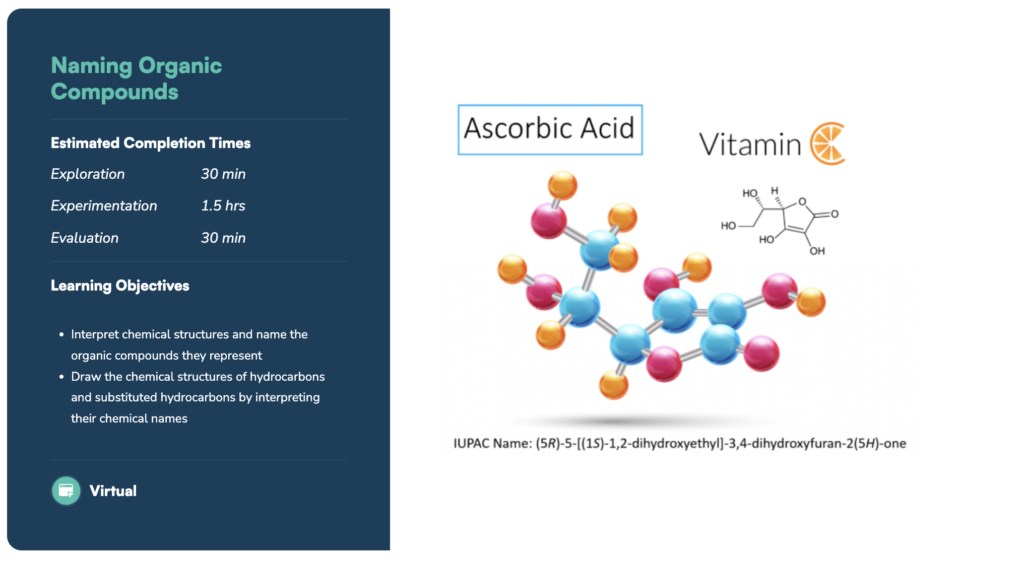
Naming Organic Compounds
In this virtual chemistry lab, students will better understand the chemical structures of organic compounds.
Want to get a real feel for our chemistry kits? Request a sample kit.
Supporting Rigor and Readiness Across Chemistry Labs
Well-designed chemistry labs do more than teach content. They help students build confidence working with real data, understand the relationship between theory and experiment, and develop the analytical skills required for future coursework and careers.
Labs like our ionic reactions, chemical and physical changes, and stoichiometry demonstrate how hands-on chemistry labs and virtual preparation can work together to maintain rigor while managing safety, access, and instructor workload. This blended approach allows college chemistry labs to scale across formats without sacrificing learning quality or consistency.
When chemistry labs are built around preparation, practice, and support, instructors can focus on teaching, and students can focus on discovery, wherever learning takes place.
Discover more articles
Teaching & Learning
How to Deliver High-Quality Anatomy and Physiology Labs Online and On-Campus
[rt_reading_time] min read
Teaching & Learning
How to Deliver High-Quality Biology Labs Online and On Campus
[rt_reading_time] min read
Teaching & Learning
How to Deliver High-Quality Chemistry Labs Online and On Campus
[rt_reading_time] min read