
February 4, 2026 | Pillar Content | Written by Victoria Guzzo | 3 min read

High-quality college biology labs can be delivered online and on campus by combining virtual labs for preparation with hands-on lab kits for real-world application. This blended approach ensures consistent learning outcomes, supports student readiness, and reduces instructor workload for biology labs online and on campus.
Delivering biology labs online or on campus has always required balance. These courses sit at the intersection of scientific rigor, student confidence, and real-world skill development. Today, that balance is harder to maintain. Institutions are expanding their online and hybrid offerings, student expectations are shifting, and instructors are carrying the weight of lab prep, logistics, and grading on top of ensuring student success.
The challenge is not whether a college biology lab can be delivered in an online and on-campus setting. They already are. The real question is how to deliver a biology lab online, on campus or in hybrid format that preserve rigor, support student readiness, and remain sustainable for faculty across course formats.
Recent findings from Beyond the Lab Bench: Tackling Faculty Strain, Student Readiness, Allied Health & AI point to a consistent pattern across higher education: strong outcomes come from intentional lab design, student preparation, and instructor support—not from the delivery format alone.
Can College Biology Labs Deliver the Same Rigor Across Course Formats?
In higher education, biology labs play a foundational role. For many students, these courses represent their first sustained exposure to scientific investigation. Whether students are pursuing healthcare careers or completing general education requirements, the expectations for rigor and skill development remain high.
Data from the 2025 Annual Lab Report shows that course format itself does not determine quality. Instead, consistency in expectations, preparation, and assessment defines whether college biology labs succeed. Instructors overwhelmingly cite student preparedness as the biggest obstacle to effective lab instruction. In fact, 90% report that lack of readiness undermines lab outcomes across online and on-campus formats.
Students feel this gap as well. Roughly 40% say they feel unprepared when entering lab activities, and nearly half report low confidence when performing experiments. When preparedness falters, instructors end up spending valuable lab time reviewing basics instead of reinforcing higher-order thinking and analysis.
Despite the differences in course delivery formats, the common thread has become clear. Faculty are burning out trying to patch readiness gaps, and students are losing confidence when they can’t keep up.
This lack of preparedness does more than slow down lab time. It also shapes how students think about their lab experience and what they expect from college biology labs moving forward.
Student Expectations Are Changing for College Biology Labs
Student demand for flexibility has become a defining feature of higher education. The 2025 Annual Lab Report found that nine in ten students consider access to online biology lab options important for their general requisites, and nearly 30 percent say they would enroll elsewhere if a lab course were not offered online.
At the same time, flexibility does not mean students are willing to sacrifice experience. Eighty-four percent of students report that hands-on labs make courses more engaging and help them retain information. That means, students taking online biology labs increasingly expect experiences that mirror the rigor and relevance of on-campus labs.
One student summarized this expectation clearly:
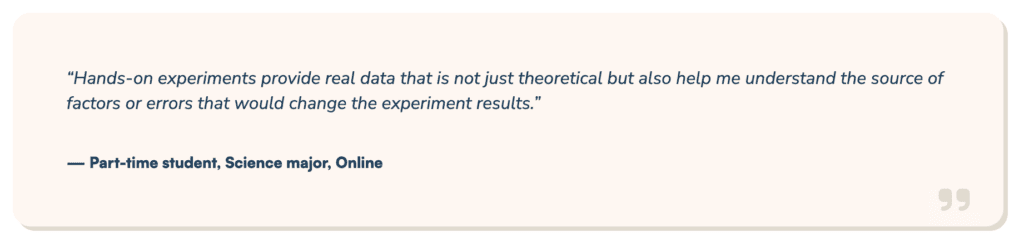
For college biology labs, this combination of flexibility and depth is no longer optional. It is the baseline students expect.
Instructor Workload Is the Elephant in the Room
While student expectations drive demand, instructor capacity determines feasibility. Research highlights the strain faculty face when delivering biology labs across formats.
- 68% of instructors across both two- and four-year institutions say the time spent managing supplies & prepping is a significant challenge.
- 55% are responsible for doing all their own lab prep.
These pressures are especially pronounced for instructors teaching both online and on-campus sections, where duplicative systems and inconsistent materials increase complexity and present challenges that can’t be ignored.
One full-time community college instructor summarized their frustration by saying, “I have tried absolutely everything. Everything I try costs me time and has little impact on student preparedness. Sometimes it makes it worse.”
Biology lab solutions that reduce prep, streamline logistics, and standardize experiences across formats are essential for maintaining quality and instructor sustainability.
Hands-On Lab Kits Reduce Instructor Burden in On-Campus Biology Labs
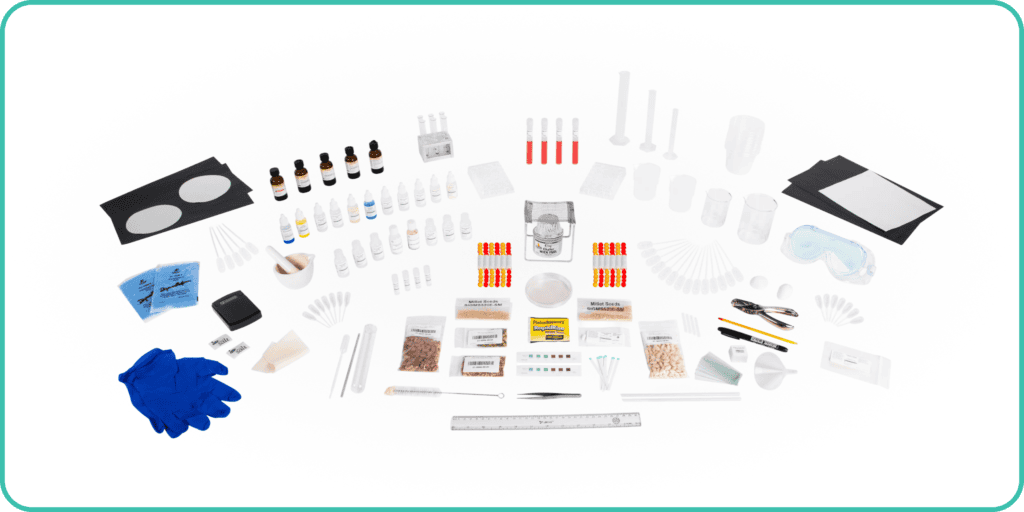
While much of the conversation often centers around how to deliver the online biology lab, on-campus courses face many of the same constraints. Instructors are still responsible for sourcing materials, managing inventory, and ensuring every student has access to the same tools at the same time.
As enrollments grow and sections multiply, those logistical demands scale quickly and managing materials can quickly become a major source of instructor workload. Sourcing supplies, tracking inventory, and preparing labs for multiple sections takes time away from teaching and student support.
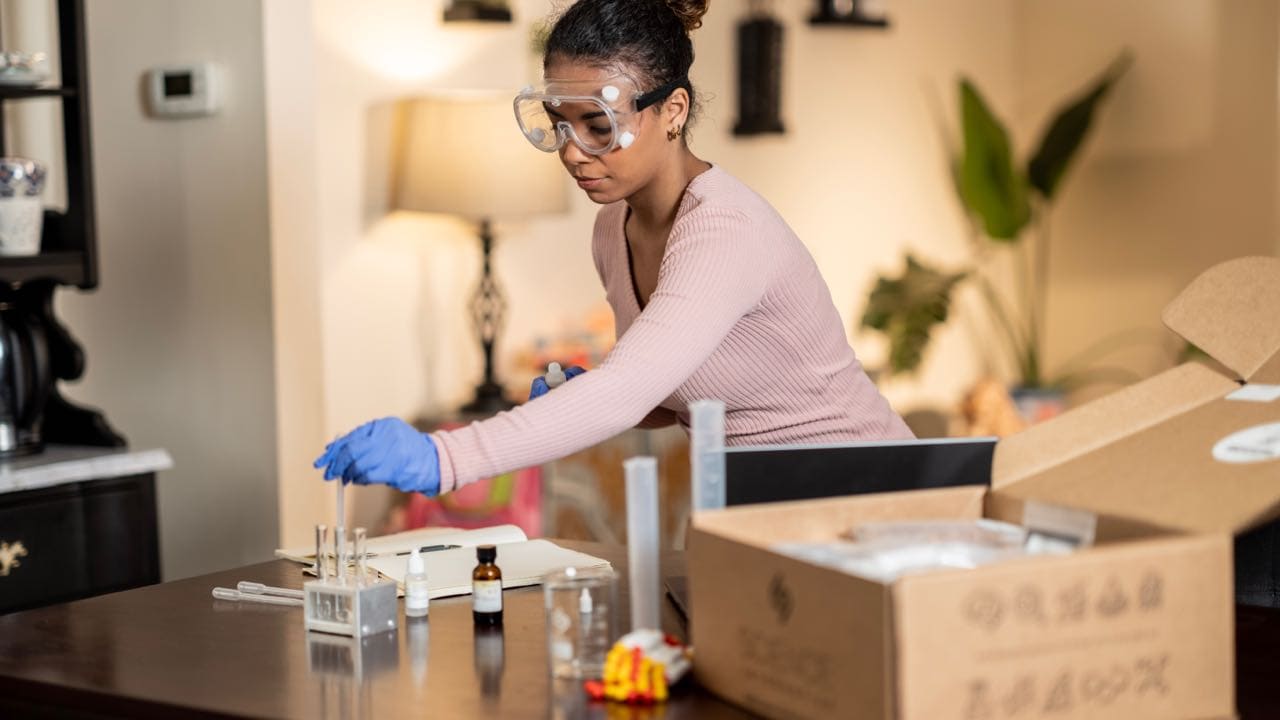
Pre-assembled hands-on lab kits help solve this challenge by standardizing materials and simplifying distribution. Kits can be purchased through campus bookstores or included in course fees, ensuring students have consistent access to the same lab materials while reducing logistical work for instructors.
The time savings become even more important as programs scale. Dr. Charles Murrieta, Forensic Science at the University of Nebraska–Lincoln, shared how pre-assembled kits for their on-campus program support consistency and growth:
“Our instructors save hours each day using pre-assembled kits, allowing them to focus on student learning. They don’t have to spend time sourcing materials, preparing labs for each student, or cleaning up, allowing us to scale the program from 1 to 5 sections.”
For college biology labs, hands-on kits support consistency across sections, protect instructor time, and preserve the rigor students expect from on-campus lab experiences.
Why Virtual Biology Labs and Hands-On Labs Work Best Together
What’s more, research consistently shows that blended lab models outperform single-modality approaches. Virtual labs and hands-on labs serve different purposes, and together they create stronger outcomes.
Virtual labs help students prepare. They allow learners to explore concepts, practice procedures, and repeat experiments in a low-stakes environment. Eighty-six percent of students using virtual simulations report satisfaction, and many say simulations improve conceptual understanding, which can be an especially important pre-lab exercise for on-campus students.
Hands-on labs remain critical for skill development and confidence. Seventy-six percent of instructors say hands-on labs help students gain the knowledge and competencies required for course outcomes. Students agree, citing greater engagement and retention when active learning and physical experimentation is part of the lab experience.
As one student noted:
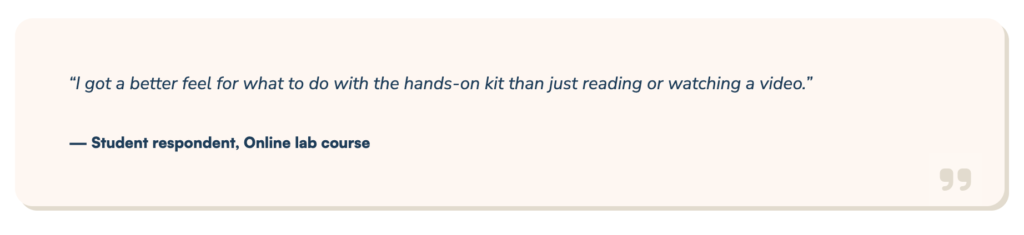
Most students echoed that sentiment: 75% of students favor a hands-on component in their online lab with nearly half opting for a mix of hands-on and virtual labs.
Similarly, instructors said the MOST IMPORTANT reasons for incorporating this modality into online courses was to ensure quality.
- 80% of instructors chose to incorporate a hands-on lab component in their online course in order to ensure quality.
- 68% of instructors using hands-on labs said they were comparable to an in-person lab experience.
For college biology labs, blending virtual biology labs with a hands-on experience creates preparedness before lab work and deeper understanding during it.
From enzymes to prokaryotes, take a closer look at our biology labs in action to see how hands-on experiments and virtual labs work together to reinforce core concepts and skills.
Balancing Access, Cost, and Rigor in Higher Education
Affordability remains a central concern for students. The 2025 Annual Lab Report found that 71% of students believe the cost of hands-on lab kits aligns with the value they receive, particularly when compared to the full costs of attending on-campus labs.
Virtual biology labs help control costs and expand access, while hands-on labs preserve rigor and confidence. Together, they allow biology labs for college programs to meet outcomes without placing undue burden on students or faculty.
High-quality biology labs are achievable across online and on-campus formats when programs prioritize preparedness, blended delivery, and instructor sustainability.
As one on-campus instructor observed:
“Virtual labs (pre-labs) are absolutely critical. When students do a trial experiment first, they’re calmer, more confident, and actually ready to learn when they walk into the lab.”
By aligning virtual biology labs, hands-on labs, and streamlined lab systems, college biology labs can deliver consistent rigor, improve student confidence, and reduce instructor workload.
The future of biology labs in higher education is less about choosing a format and more about designing biology lab solutions that work wherever learning happens.
Discover more articles
Teaching & Learning
How to Deliver High-Quality Anatomy and Physiology Labs Online and On-Campus
[rt_reading_time] min read
Teaching & Learning
How to Deliver High-Quality Biology Labs Online and On Campus
[rt_reading_time] min read
Teaching & Learning
How to Deliver High-Quality Chemistry Labs Online and On Campus
[rt_reading_time] min read