
October 8, 2026 | Pillar Content | Written by Victoria Guzzo | 2 min read

Science Interactive’s fourth Annual Lab Report finds that as lab enrollment grows, readiness is not keeping pace, and instructors are spending scheduled lab time reteaching instead of advancing students.
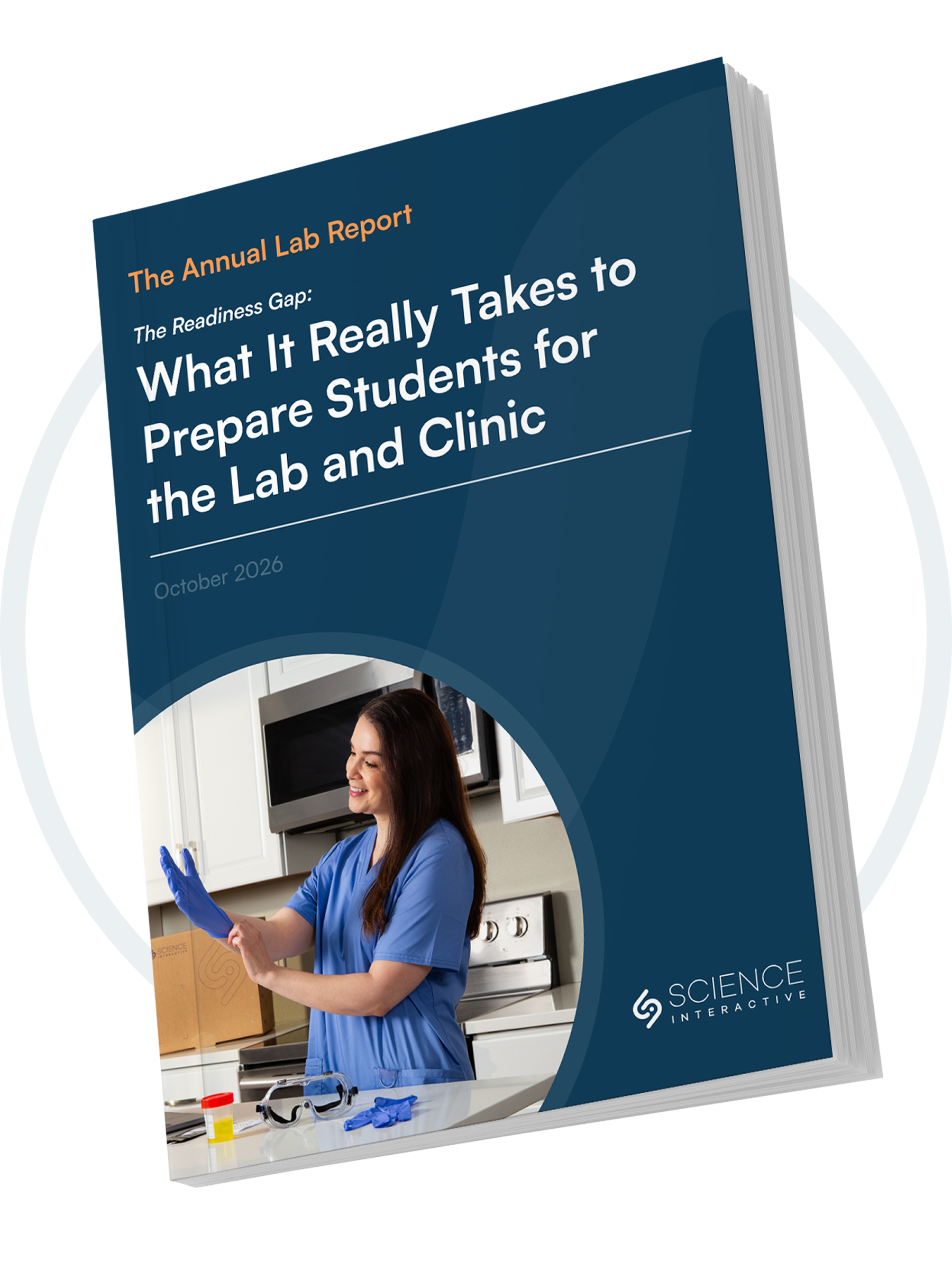
YULEE, FL–OCTOBER 8, 2026–Science Interactive, a leader in supporting effective science education, released its fourth Annual Lab Report, The Readiness Gap: What It Really Takes to Prepare Students for the Lab and the Clinic. The report examines the challenges facing programs as lab enrollment grows, faculty workloads increase, technology evolves and demand for Allied Health programs rises.
The findings point to a readiness challenge that is placing additional pressure on already-stretched lab programs. As enrollment grows, instructors are spending more scheduled lab time reteaching foundational skills, while also managing the significant preparation required to keep labs running. The student readiness challenge is particularly pressing in Allied Health, where programs are expanding while working to ensure graduates are ready for practice.
“Readiness has become an increasingly important part of the conversation around lab education,” said Dr. Caitlin Runne-Janczy, Chief Academic Officer at Science Interactive.
“When students arrive without the foundational skills they need, they miss out on the hands-on time that builds real confidence and competence. Giving students more effective ways to practice before they start a lab helps close those gaps earlier, so every student can get the most from their lab time and build the kind of skills they’ll rely on in their careers.”
Key Findings from the 2026 Lab Report
The report draws on responses from 1,307 students, instructors and administrators, collected between July and August 2026. Among this year’s findings:
Lab enrollment is growing, increasing pressure on programs.
Eighty percent of institutions report lab enrollment growth in at least one format, and 40% report growth across both online and on-campus formats. Pre-health programs lead enrollment growth for the second consecutive year, with 73% of institutions reporting growth.
The readiness gap is taking time away from lab instruction.
Eighty-one percent of instructors lose at least 10% of scheduled lab time reteaching material students were expected to know. For 35%, that loss exceeds a quarter of scheduled lab time.
Students feel confident, but foundational readiness remains a concern.
Only 12% of instructors say their students arrive generally ready for the lab. They also report that only 37% of their class have the procedural knowledge needed for the lab. The findings point to the value of giving students more opportunities to practice foundational skills before scheduled lab time.
Students want more opportunities to practice before lab.
Eighty-nine percent of students say an interactive virtual pre-lab that allows them to practice the experiment would help them feel more prepared. Instructors also rank practice before the lab as their top intervention. Yet only 28% of instructors offer an interactive resource.
Simulation is viewed primarily as preparation for hands-on learning.
Only 3% of instructors believe simulation can replace hands-on lab work. Sixty-six percent say it works best as preparation for hands-on experiences, while 95% of administrators consider hands-on experience essential or valuable, including in online courses.
Allied Health programs face growing pressure to expand.
Ninety-five percent of administrators report pressure to grow Allied Health programs, up from 82% last year. Yet 89% of instructors say their graduates require some level of supervision or oversight in order to practice independently. Seventy percent of instructors agree that passing a licensure exam means a graduate is ready to practice safely, highlighting the importance of preparation beyond simply meeting an assessment requirement.
Faculty continue to carry significant operational demands.
Half of instructors report handling all of their own lab preparation, while 63% identify supply management as a recurring challenge. These demands add another layer of pressure as institutions manage growing enrollment.
AI concerns are running ahead of institutional action.
Eighty-nine percent of instructors and 96% of administrators report concerns about AI’s effect on academic integrity. Despite widespread concern, very few institutions have a formal AI policy for students.
Preparing Students for the Lab & Beyond
The findings point to a clear opportunity for programs: address readiness before students reach scheduled lab time.
Interactive pre-lab practice gives students a place to work through concepts, procedures and mistakes before those challenges take time away from hands-on instruction. Nearly nine in 10 students surveyed say this type of preparation would help them feel more ready, while instructors identify practice before the lab as their top intervention.
As institutions expand lab access and respond to demand in pre-health and Allied Health programs, the report highlights various approaches to preparing students for the work that happens once they reach the bench, rather than using valuable lab time to address foundational and procedural gaps.
The full 2026 Annual Lab Report: The Readiness Gap: What It Really Takes to Prepare Students for the Lab and the Clinic, including findings on student readiness, faculty workload, lab enrollment, Allied Health programs, simulation and AI, is available for download here.
Science Interactive will host a live webinar on October 22 from 2:00 to 3:00 PM ET, during which Dr. Caitlin Runne-Janczy will share this year’s findings. Register here to reserve your spot.
About Science Interactive
Science Interactive makes science education accessible to all students, no matter where they’re learning from. Our complete lab solution combines customizable kits, a rigorous digital curriculum, and cutting-edge technology that makes it easier to create and deliver a hands-on lab experience for students in online and on-campus courses. Over 800 institutions nationwide partner with Science Interactive to expand access to their science programs, increase student engagement, and improve success rates. To learn more, visit scienceinteractive.com.
Contact: Lauren O’Brien, Chief Marketing Officer
Discover more articles
Students Feel Ready. Instructors See a Different Story: The 2026 Lab Report Exposes a Lab Readiness Gap
[rt_reading_time] min read
Science Interactive Named 2026 Tech & Learning’s Award of Excellence Winner
[rt_reading_time] min read
Student Engagement
Student Engagement
What New MA Instructors Wish They’d Known Before Their First Semester
[rt_reading_time] min read