
November 16, 2026 | Pillar Content | Written by SI | 5 min read

Picture a Tuesday afternoon chem lab. A student has gloves on, the burette clamped, and the manual open to step four. Trouble is, step three went sideways about ninety seconds ago, and nobody caught it.
Most instructors could sketch that scene from memory. It keeps happening because the bench is often the first place students meet the experiment at all. They’re rehearsing and performing in the same two-hour block, with live reagents, a ticking clock, and a grade on the line.
Think of it this way…no orchestra plays a concert piece cold. No pilot-in-training’s first landing happens with a jet full of passengers. Yet labs ask students to do roughly that, week after week.
But here’s the encouraging part. Data in the 2026 Annual Lab Report suggests the long-running fight over simulation versus hands-on labs has mostly burned itself out. Instructors, administrators, and students landed in the same spot. So the more useful conversation now is about order of operations: what comes first, what comes second, and why the sequence matters as much as the tools.
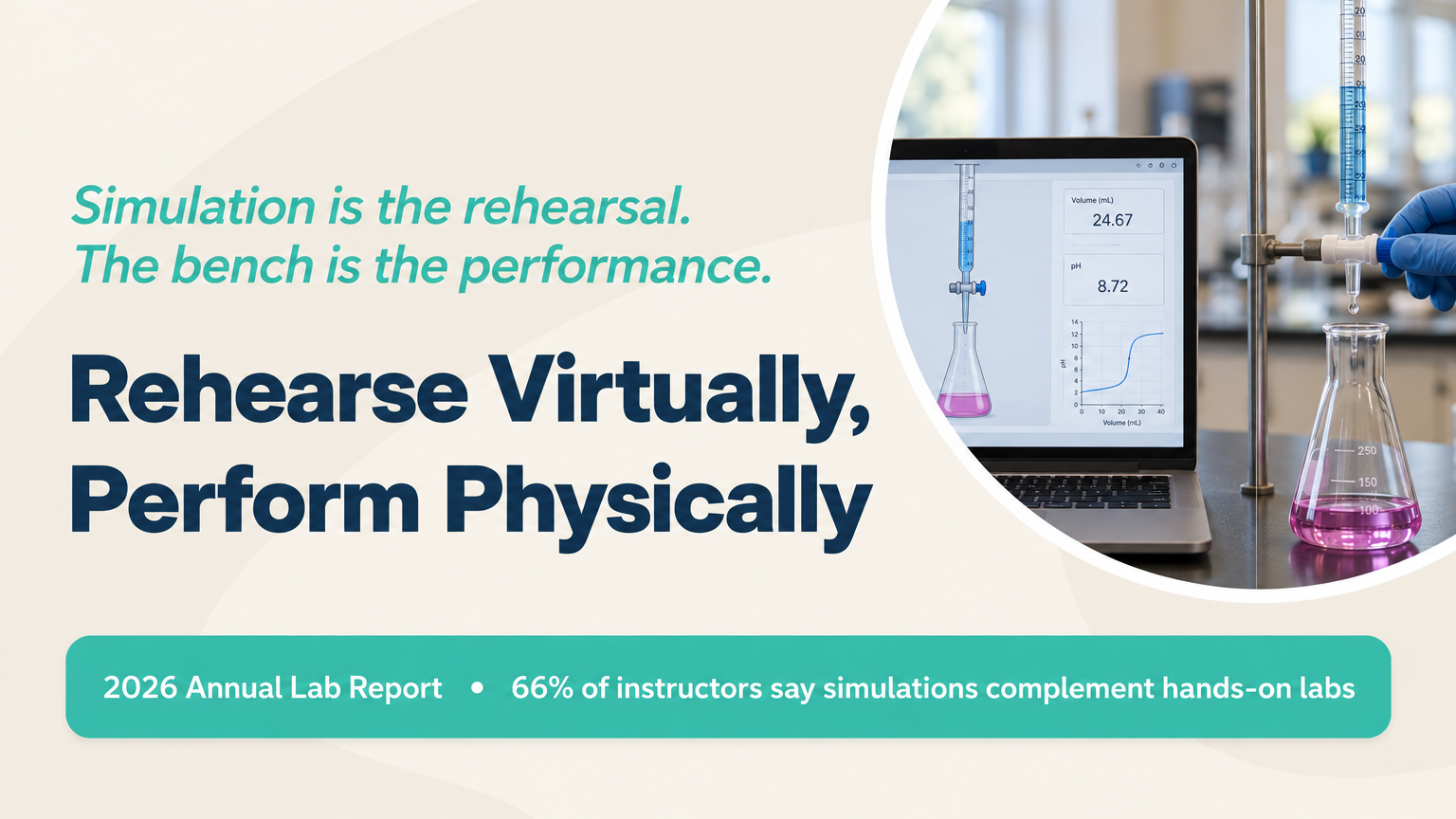
The bottom line: Treat simulation as the rehearsal and the bench as the performance. Sequence them on purpose, and students show up practiced instead of meeting the experiment for the first time with a pipette in hand.
The Simulation vs. Hands-On Debate
For years, conference panels framed this as a cage match. Screens in one corner, beakers in the other, and plenty of strong opinions in the cheap seats. The 2026 survey of 1,307 students, instructors, and administrators suggests the bout is over, and both sides walked away with something.
Instructors who taught a lab in the past year were asked how they see virtual simulations. Here’s how they answered:
- 66% say simulations complement or supplement hands-on labs
- 26% say they add little value
- 5% aren’t sure
- 3% say simulations can replace hands-on work
That last number deserves a second look. Almost nobody who teaches labs thinks a screen can stand in for physical work. Administrators agree, with 95% calling hands-on experience essential or valuable even in online labs.
Students, meanwhile, give both formats good marks. Eighty-seven percent say hands-on labs helped them learn the knowledge and skills they needed, up from 84% last year. Eighty-nine percent say the same about virtual simulations. And when asked which format they preferred, 44% picked a combination of hands-on work and simulation, more than any other option.
Outside research lines up neatly. In a widely cited review in Science, Ton de Jong, Marcia Linn, and Zacharias Zacharia concluded that “combinations of virtual and physical laboratories offer advantages that neither one can fully achieve by itself” (de Jong, Linn & Zacharia).
So the “which one” question has a pretty settled answer: both. The harder and more interesting question is how to arrange them, and that’s where a lot of course designs still leave value on the table.
Why the First Run Shouldn’t Happen at the Bench
A lab session piles a lot onto a student’s brain at once. New equipment. A new procedure. Concepts they last saw in lecture three weeks ago, or never quite nailed down. Safety rules stacked on top of all of it.
Science education researchers have flagged this pile-up for decades. In their 2017 framework for designing pre-labs, Hendra Agustian and Michael Seery lean on earlier work by Johnstone and Wham, who found that “learning is severely hampered in a high information situation.” For many experiments, the authors write, that information “swamps the working memory” (Agustian & Seery, 2017).
Once working memory floods, students slip into recipe mode. They follow steps without asking why, and the science this lab was built to show slides right past them.
The 2026 report, in fact, shows how common that is. Instructors estimated what share of a typical class arrives ready across five areas, and procedural knowledge came in dead last:
| Readiness area | Share of class instructors say arrives ready |
| Confidence | 46% |
| Applied ability | 46% |
| Foundational knowledge | 44% |
| Quantitative skills | 44% |
| Procedural knowledge | 37% |
And then, the cost of that gap lands squarely on faculty:
- 81% of instructors lose 10% or more of scheduled lab time reteaching material students should’ve walked in with
- 35% lose more than a quarter of it
- 23% of students say they struggled to understand safety protocols, and 19% report misusing equipment
As the report puts it, a course losing a quarter of its lab time is delivering three-quarters of its curriculum, at full tuition and full credit.
Now for the hopeful bit. Procedural knowledge is the weakest area, and it’s also the easiest one to repair. A foundational gap usually takes a whole prior course to close. A procedural gap can close with structured practice right before the lab, which means the missing knowledge can be supplied at exactly the moment students need it.
A Quick Detour Through the Operating Room
Medicine wrestled with the rehearsal question a while back, and the evidence is hard to wave off.
In 2002, a team led by surgeon Neal Seymour ran a randomized, double-blinded study with surgical residents. Half trained on a virtual reality simulator before performing part of a gallbladder removal in the operating room. The other half went in with standard, non-virtual training only. The results, published in Annals of Surgery showed that:
- Simulator-trained residents were 29% faster at the gallbladder dissection
- They made roughly six times fewer errors, averaging 1.19 per case against 7.38
- Residents without simulator practice were five times more likely to injure the gallbladder or burn nontarget tissue
It was a small study, just 16 residents, so read it as a strong signal rather than the final word. Even so, it’s still widely cited in conversations about simulation-based surgical training.
Aviation takes a similar road. Commercial pilots log hours in full-motion simulators before they fly a new aircraft type with passengers aboard. Nobody in that industry thinks the simulator replaces the airplane. They just refuse to let the airplane be where the basics get learned.
A titration isn’t gallbladder surgery, obviously. But the distance between the two shrinks fast once you get to Allied Health. A nursing student working a dosage calculation is doing lab math with a patient attached to the answer. The stakes climb; the logic of rehearsing first stays exactly the same.
The Practice Sequence, Step by Step
Here’s what rehearse-then-perform can look like inside a real course. Below is a five-stage sequence built on what instructors and students said they need. It works on campus and online, and each stage can stretch or shrink depending on the lab.
1. Orient: refresh the concepts first
Before anyone touches equipment or opens a simulation, give students a short concept refresher tied to that week’s lab. Think ten focused minutes, not a mini-lecture. Both groups ranked this second on their wish lists: 41% of students want a refresher module on key concepts, and 32% of instructors chose a prerequisite refresher or bridge module.
The reason is retention. While only 2% of students say they skipped the required prerequisites, 56% of instructors name missing prerequisite knowledge as a top cause of unpreparedness. Students took the course. The knowledge simply faded somewhere between that final exam and this lab.
2. Rehearse virtually: run the experiment before running the experiment
This is the heart of the whole thing. Students work through a trial version of the lab in simulation. They set up, follow the procedure, collect data, and (this part is key) get things wrong without wasting reagents or losing points.
Instructors already see this as simulation’s sweet spot:
- 57% name preparing students before a hands-on lab as where simulation adds the most value
- 54% point to low-stakes practice and feedback
- 41% value the chance to repeat or practice safely
Students want it too, and they’ve said so through three cycles of Annual Lab Report data collection.
Demand for a virtual pre-lab with a trial experiment has held at 83% in 2024, 91% in 2025, and 89% in 2026.
“I would say practice simulations before hands-on labs would help me feel more prepared.”
Anonymous full-time student, biology
3. Check readiness: a quick gate before the bench
Plenty of sequences skip this step, and it’s a costly skip. Students who feel ready and students who are ready turn out to be two different crowds. Eighty-eight percent of students say they’re confident in the math and data analysis their labs require. Instructors estimate only 44% can do that work unaided.
A short, low-stakes diagnostic does two jobs at once:
- It shows the instructor who needs a hand before the session starts
- It shows students what they don’t know yet, while there’s still time to fix it
Three to five questions on the procedure, the safety steps, and the key calculation usually gets the job done.
4. Perform physically: the bench is where skill gets built
Now students do the real thing, either in a campus lab or with an at-home kit. They’ve seen the procedure, fumbled it once on screen, and cleared the readiness check. That frees the session for observation, troubleshooting, and the trial and error that only physical materials give you.
“Lab simulations and virtual lab instruction are not meant to replace the actual hands-on lab experience. They supplement and enhance it.”
Raffi Manjikian, Assistant Professor of Chemistry, Hudson County Community College
5. Loop back: bring simulation in again afterward
The virtual simulation’s job doesn’t wrap up once the bench work starts. After the lab, it earns its keep in a few ways:
- Remediation for students who struggled, which 49% of instructors already use it for
- Seeing the unseeable, like molecular behavior a physical lab can’t show
- Repeat practice ahead of a lab practical or the next experiment in the sequence
Here’s the whole sequence at a glance:
| Stage | What students do | What instructors get back |
| 1. Orient | Review the key concepts behind this lab | Fewer foundational detours mid-session |
| 2. Rehearse virtually | Run a trial version and make mistakes safely | Students who already know the procedure |
| 3. Check readiness | Take a short low-stakes diagnostic | An early read on who needs help |
| 4. Perform physically | Do the bench or at-home kit work | Lab time spent on the science |
| 5. Loop back | Revisit in simulation and remediate | A second pass without new materials |
One student in the survey summed up the payoff neatly: “The virtual simulations were helpful for understanding concepts, while hands-on activities gave me practical experience.”
Where Good Sequences Fall Apart
Even a well-built sequence can stall. Four failure points keep popping up in the data, and each one has a fairly simple fix.
1. The rehearsal is optional, so it gets skipped.
Forty-seven percent of students spend under an hour preparing for a lab session. Among instructors who assign no pre-lab at all, half say it’s because they don’t believe students would complete one. That instinct makes sense, and it’s also the best argument for grading the rehearsal, even lightly. Among students who had a required pre-lab, 84% said it helped them feel more prepared. An optional pre-lab mostly reaches the students who were going to prepare anyway.
2. The rehearsal is a reading assignment.
Sixty-one percent of instructors use written in-house pre-lab exercises. Only 28% use interactive virtual pre-labs that include a mock experiment. Reading about a procedure and attempting one builds different muscles. When students rated supports for online labs, the top three were all things they could work through on their own time:
- Virtual simulations: 93% helpful
- Asynchronous instructor videos: 92%
- Practice simulations before hands-on labs: 91%
3. The simulation always walks them to the right answer.
The report flags a common gripe: many simulations steer students toward the same correct result every time. That’s tidy, but it skips the part where learning happens. Good rehearsal leaves room to fail. Look for simulations that let a step go wrong and show students what that costs.
4. There’s no performance at all.
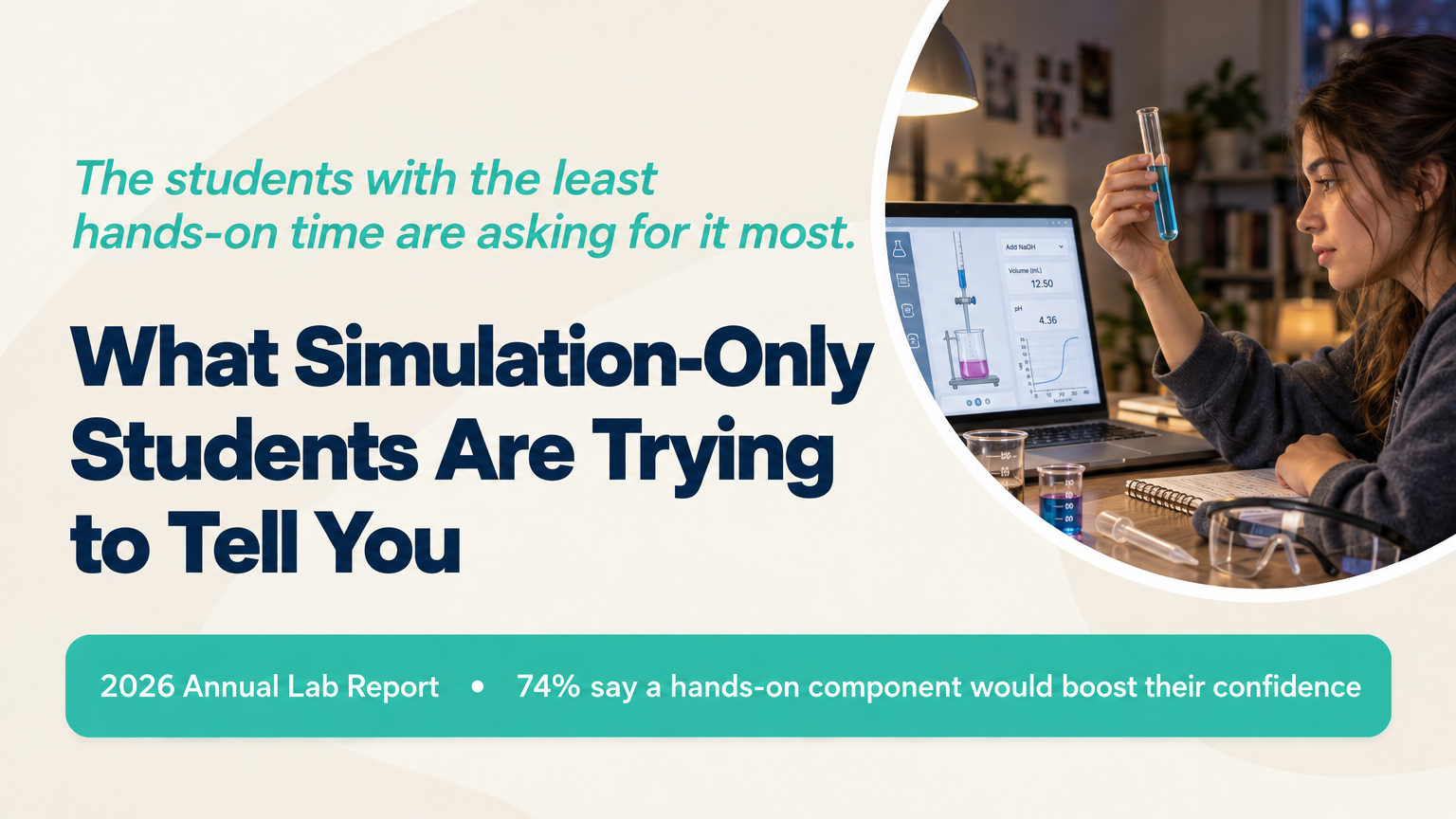
In simulation-only sections, the share of students saying a hands-on component would make them more confident jumped from about 60% to 74% in a single year. The 2026 sample leaned more toward online-only students (60%, up from 46%), which may account for some of that jump. The direction, though, is hard to miss. Students who only rehearse can tell they haven’t performed yet.
One honest caveat. The Science review by de Jong and colleagues found that combined labs succeeded “independently of the order of investigation” when it came to conceptual learning. So the strongest case for rehearsing first comes from procedural readiness, working memory, safety, and recovered lab time, which is exactly where the 2026 data shows the damage. Concept gains may show up whichever way you sequence it.
Making the Performance Count
Eighty percent of administrators report lab enrollment growing in at least one format (online/hybrid or on-campus), while lab space, faculty, and clinical placements stay stubbornly tight. That math doesn’t leave much slack, which means every bench hour has to pull its weight.
A deliberate practice sequence is one of the few moves that doesn’t call for a new room or a new hire. With 81% of instructors losing scheduled lab time to reteaching, winning back even part of it adds real capacity, and it’s about the cheapest kind a department can find.
Looking down the road a few years, the programs that get this right probably won’t argue about format much at all. They’ll talk about sequence, the way a stage director talks about a rehearsal schedule:
- Concepts first
- Then a run-through where mistakes are free
- Then a quick check
- Then the performance
And once students set up at the bench already rehearsed, the questions in the room start to change. Fewer people ask “What do I do next?” More of them ask “Why did it turn that color?”
While that shift sounds small, it changes how the whole session runs. Students who already know the steps have attention left over for what’s happening in front of them. They notice the color change that came too early, the reading that seems off, or the result that doesn’t match what the simulation showed. Those moments of friction are where a lab earns its spot in the curriculum, because they push students past following directions and into deeper level thinking. A good rehearsal is how more students get there.
For the full picture, read the 2026 Annual Lab Report for the complete findings on student readiness, faculty strain, lab modalities, Allied Health, and AI.
Discover more articles
Rehearse Virtually, Perform Physically: A Practice Sequence That Works
[rt_reading_time] min read
What Simulation-Only Students Are Trying to Tell You
[rt_reading_time] min read
Students Feel Ready. Instructors See a Different Story: The 2026 Lab Report Exposes a Lab Readiness Gap
[rt_reading_time] min read