
November 16, 2026 | Pillar Content | Written by SI | 4 min read

The students with the least hands-on time are the ones asking for it most loudly.
A chemistry student put it plainly in our 2206 Annual Lab Report: “There was a sense of real world confidence that was lost in the simulations, and oftentimes, things didn’t quite connect the same as in-person labs.”
That’s one voice. The numbers behind it are harder to brush off.
In the 2026 Annual Lab Report, students whose labs ran on simulation alone were asked whether a hands-on component would make them feel more confident. Seventy-four percent said yes.
A year earlier, that figure sat around 60%. It’s the biggest year-over-year shift on the student side of the whole dataset.
Here’s what makes that finding so interesting. These same students mostly like their simulations. So read this less like a complaint and more like a very specific recommendation.
The smart response keeps what simulation does well, raises the bar on the simulations themselves, and adds physical work where students can feel the gap. That takes a little more nuance than “add a kit and call it a day,” so let’s walk through it.
The Loudest Signal in the Modality Data
Let’s start with the good news for simulation because there’s plenty of it.
- 89% of students say virtual simulations helped them learn the knowledge and skills they needed, up from 85% in 2025.
- 66% of instructors say simulations complement or supplement hands-on labs.
- Only 3% of instructors think simulation can replace hands-on work.
So nobody’s tossing out the virtual lab. Students rate it highly, and most faculty see a clear role for it.
Now look at the other side of the ledger:
- 74% of simulation-only students say a hands-on component would raise their confidence, up from about 60%
- 83% of instructors who use simulations say their students would have learned more with hands-on work too
- 44% of students prefer a combination of hands-on work and simulation, more than any other format
The 2026 student sample leaned more toward online-only learners (60%, up from 46% in 2025), which may account for some of that jump. Treat the exact size of the shift as a strong signal rather than a precise measurement. The direction, though, matches what instructors report from their side.
Put those two lists next to each other and a picture comes into focus. Students learned from the simulation. They also sense there’s a kind of knowing they haven’t gotten yet. That second part is worth unpacking.
What “Confidence” Means at the Bench
When a student says a hands-on component would make them more confident, they usually aren’t talking about concepts. They’re talking about the stuff that only shows up when your hands are on real equipment.
Students in the survey described it in their own words:
“I think I missed out on the hands-on experience of physically setting up and carrying out the lab. Virtual simulations were helpful, but I would have liked more practice with real equipment and the chance to troubleshoot in a more realistic setting.”
Anonymous, part-time student, biology
“Being able to learn with my hands, learning how to use real science instruments, and being successful in most of my lab work helped build my confidence.”
Anonymous, full-time student, environmental science
Notice the words that keep coming up. Setting up. Troubleshoot. Real instruments. That’s the physical side of lab work, and it covers a handful of skills that are tough to build on a screen:
- Setup and handling: clamping glassware, calibrating a probe, measuring a volume without spilling half of it
- Reading messy results: real data is noisy, and learning to tell a bad reading from a surprising one takes practice
- Troubleshooting: figuring out why the reaction didn’t go, when no pop-up is going to explain it
- Recovery: making a mistake, catching it, and fixing it mid-procedure
Faculty value this kind of learning for good reason. As Harminder Gill, associate faculty in chemistry at University of California Extension, put it: “Authentic laboratory experiences cultivate intellectual rigor by compelling students to synthesize theoretical principles with empirical investigation.”
Instructors who chose hands-on formats for their online courses gave practical reasons too. 51% cited better student engagement, and 49% pointed to a higher quality lab experience.
So students in simulation-only sections are probably right about what they’re missing. That doesn’t mean the simulation was wasted time, though. A virtual lab has jobs of its own, and some of them no bench can match.
What a Bench Can’t Show You
Physical labs have one stubborn limit. You can only see what’s big enough, slow enough, safe enough, and cost-effective enough to put on a table.
That leaves a lot of science out of view, and according to surveyed instructors, they’re using simulation to fill those gaps.
| What simulation does | Share of instructors who value it | Examples |
| Shows what a physical lab can’t | 52% | Electron flow, molecular motion, cell processes |
| Supports remediation | 49% | A second pass for students who struggled |
| Allows safe repetition | 41% | Hazardous reactions, costly reagents, repeat trials |
| Gives low-stakes practice and feedback | 54% | Trying a procedure before the bench session |
The first row is where simulation really earns its keep. A student can watch a titration change color, but they can’t watch the ions doing the work. They can build a circuit and see a bulb light up, but the current inside the wire stays invisible. Genetics experiments that would take generations of fruit flies can run in an afternoon. Reactions too dangerous for an intro lab can happen on screen as many times as a student wants.
There’s solid research behind this. In a well-known study at the University of Colorado, physics education researchers led by Noah Finkelstein swapped real bulbs, meters, and wires for a circuit simulation that explicitly modeled electron flow (Finkelstein et al., 2005). Students who used the simulation “outperformed their counterparts” on a conceptual survey. More surprising, they also did better at building a real circuit and explaining how it worked.
The simulation helped because it showed students something the physical equipment hides, which then made their hands-on work stronger. It’s a useful reminder that the two formats feed each other.
So the case for simulation is strong when it’s doing the right job. The trouble is that not every simulation does that job well, and students can usually tell.
How to Tell a Good Simulation From a Click-Through
A common complaint shows up in the report: many simulations walk students toward the same correct result every time. One community college chemistry instructor said students “just click their way through without experiencing the wonder of a reaction done by their own hands.”
That’s a fair hit on weak simulations. It’s also a design problem with a fix.
Research on productive failure helps explain why. In a 2021 meta-analysis of 53 studies and 166 comparisons published in Review of Educational Research, Tanmay Sinha and Manu Kapur found that students who wrestled with problems before getting instruction learned more than students who got the instruction first, with bigger benefits for secondary and undergraduate students (World Economic Forum summary; study DOI). The struggle itself does part of the teaching. A simulation that never lets students get it wrong skips that part entirely.
Here’s a practical checklist for judging any virtual lab:
| Good sign | Red flag |
| Students can make real mistakes and see the consequences | Every path leads to the right answer |
| Data varies from run to run | Results are identical every time |
| Students choose settings, quantities, or steps | Students mostly click “next” |
| Feedback explains why something happened | Feedback just says right or wrong |
| It shows something the bench can’t, like particles or energy | It only copies a bench procedure on screen |
| It links clearly to a hands-on task before or after | It stands alone with no physical follow-up |
A simple test works too. Run the simulation yourself and try to break it. Add the wrong reagent. Skip a step. Read the meter wrong. If the simulation shrugs and moves you along anyway, students will learn to do the same.
The last row on that checklist ties straight back to the simulation-only students. A great simulation still leaves a gap if students never get to try the physical version. And that brings us to the audit.
How to Audit a Simulation-Only Section
Auditing a section doesn’t mean ripping it up. Most simulation-only courses exist for real reasons: cost, distance, scheduling, or a fast move online that stuck around. The goal is to find the outcomes where physical work matters most and add it there first.
Step 1: List the lab outcomes.
Pull the learning outcomes for each lab in the course. Keep it to the skills and concepts students are supposed to walk away with.
Step 2: Tag each outcome by type.
Most fall into one of a few buckets, and each bucket points toward a format:
| Outcome type | Best primary format | Why |
| Physical technique (pipetting, titrating, measuring) | Hands-on | The skill lives in the hands |
| Invisible processes (particles, current, cell activity) | Simulation | The bench can’t show it |
| Hazardous or costly procedures | Simulation first, then hands-on where safe | Practice without the risk |
| Data interpretation and error analysis | Hands-on, with simulation support | Real data is messy on purpose |
| Procedure familiarity | Simulation before the bench | Students arrive ready to work |
Step 3: Find the “hands-only” outcomes with no physical component.
These are your priority gaps. In many courses it’s a short list, often just a few core techniques.
Step 4: Add anchor experiences.
A few well-chosen hands-on labs, on campus or with an at-home kit, can cover those priority outcomes without rebuilding the whole course. Students in online sections can do physical work too, and the report suggests demand is there. 87% of students who did at-home hands-on labs said the work helped them learn what they needed.
Step 5: Ask students directly.
Put the report’s question in your end-of-term course evaluation: Would a hands-on component make you more confident? Track the answer each term. It’s one of the cheapest signals you can collect, and it tells you whether the changes are landing.
As you audit, check whether the simulations you’re keeping are doing the jobs the simulations do best, or whether they’re just a bench procedure copied onto a screen. The second kind is the first one to swap for physical work.
Listening Pays Off
The simulation-only students in this year’s data aren’t asking anyone to pick a side. They’re simply asking for the part of lab learning they can feel is missing. It’s a pretty reasonable request, and they’re making it while still giving their simulations high marks.
Looking ahead, the strongest lab courses will probably give each format a clear job. Simulation will show the invisible, let students fail safely, and get them ready before the bench. Physical work will build the hand skills, the troubleshooting instincts, and that “real world confidence” one student said was lost. Courses that blend the two on purpose will match what 44% of students already say they prefer.
There’s a nice side effect, too. Programs that ask students how confident they feel, and then act on the answer, tend to hear from those students again. Feedback loops like that can work to keep a course honest.
For the full picture, read the 2026 Annual Lab Report for the complete findings on student readiness, faculty strain, lab modalities, Allied Health, and AI.
Discover more articles
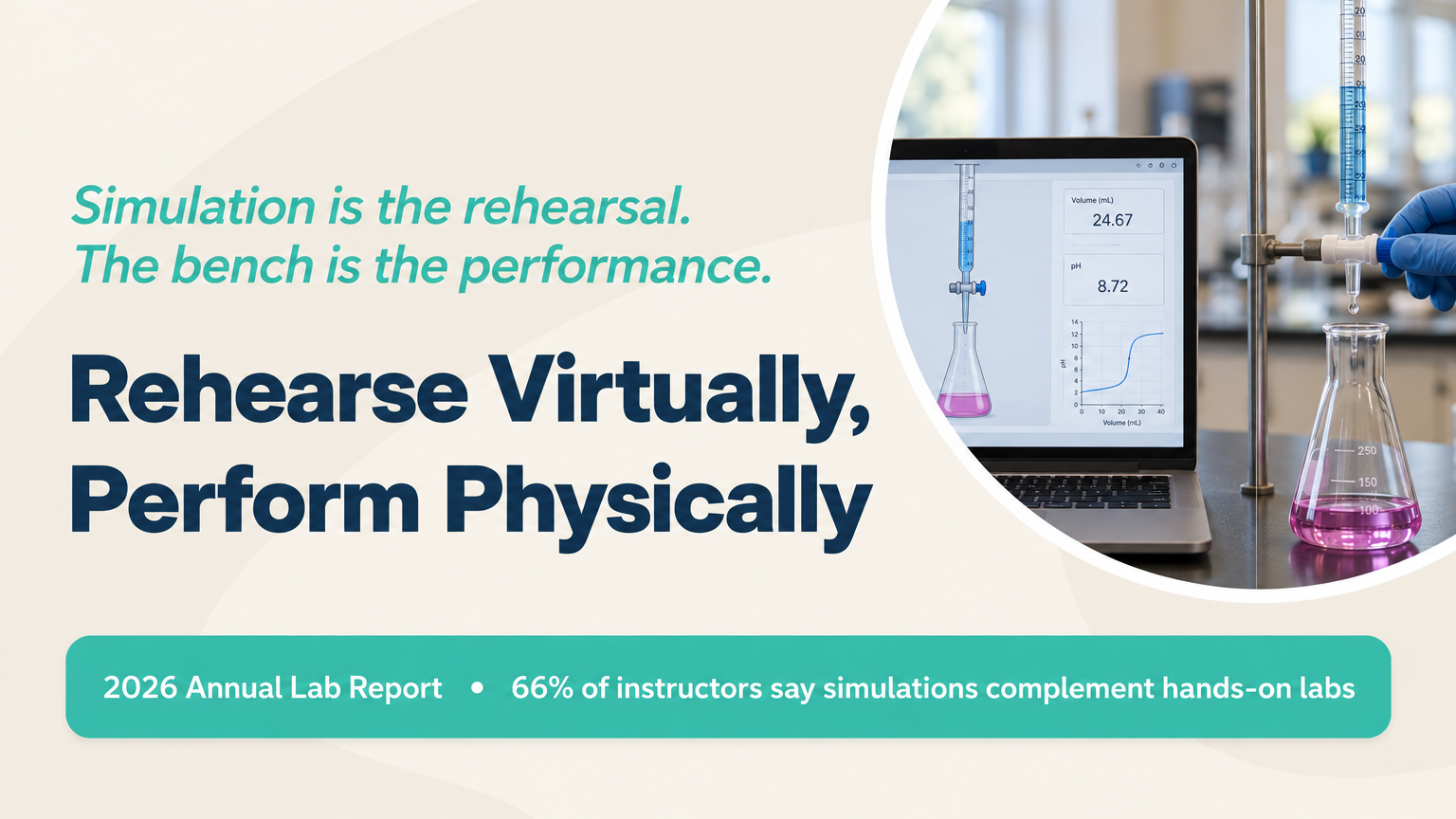
Rehearse Virtually, Perform Physically: A Practice Sequence That Works
[rt_reading_time] min read
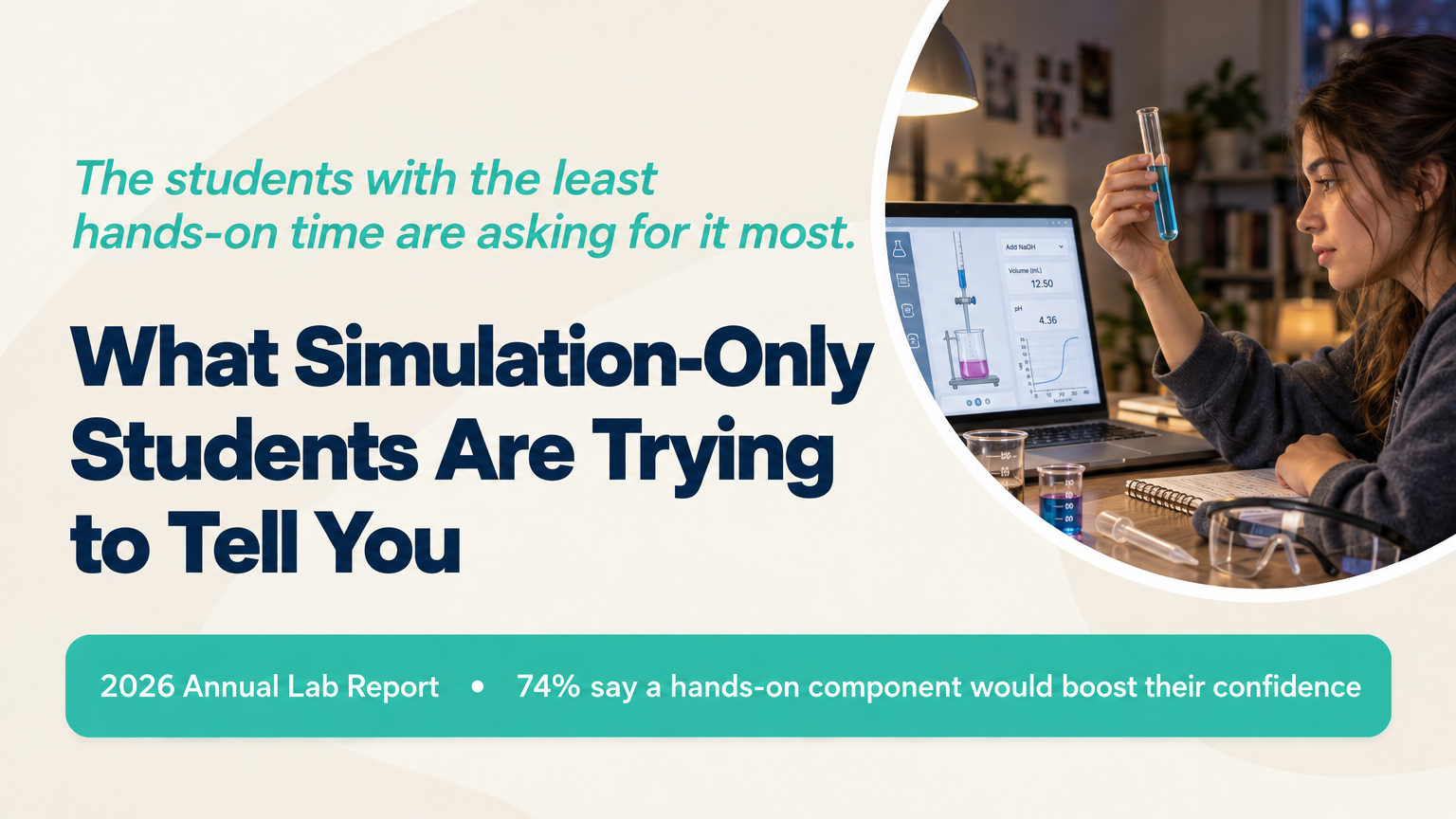
What Simulation-Only Students Are Trying to Tell You
[rt_reading_time] min read
Students Feel Ready. Instructors See a Different Story: The 2026 Lab Report Exposes a Lab Readiness Gap
[rt_reading_time] min read